The Hidden Tax Hitting Every Aucklander
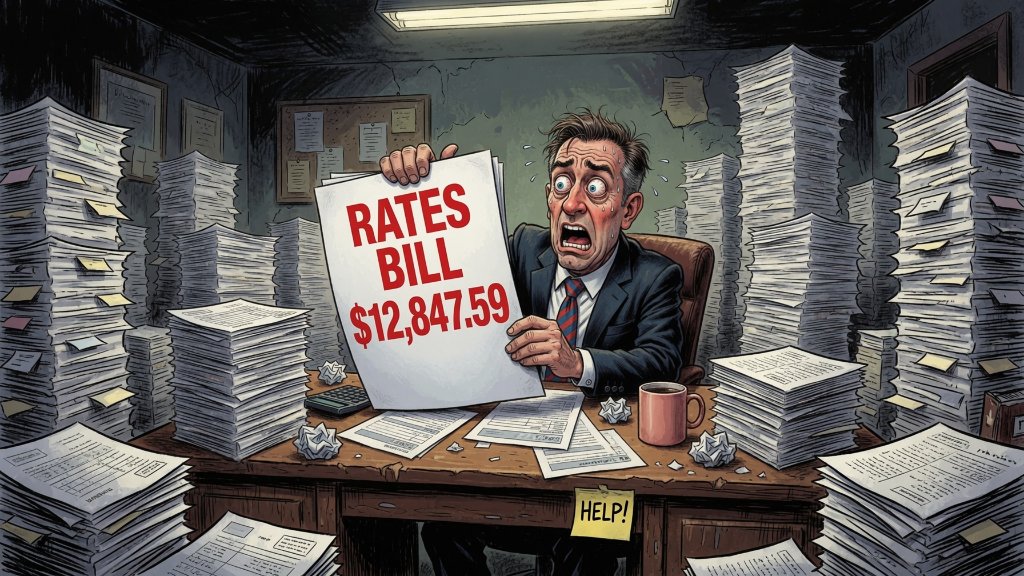
Business pays 31% of Auckland's rates but makes up only a fraction of properties. Under the business differential, urban commercial properties pay roughly 2.64 times the residential rate — a share deliberately locked in under Mayor Wayne Brown — and that cost is passed straight through to households as higher prices, rents and cost of living.
The Hidden Tax Hitting Every Aucklander
Business pays 31% of Auckland's rates but makes up only a fraction of properties.
Auckland's rating system contains a striking imbalance. There are roughly 640,000 to 643,000 rateable properties across the region. Of these, non-residential and rural properties — business, commercial, industrial, farm and lifestyle — number only about 80,000 to 85,000, around 13% of the total. Pure business and commercial rating units sit somewhere in the 40,000 to 50,000 range. Yet under Auckland Council's policy, business is required to contribute 31% of general rates plus the Water Quality, Natural Environment and Climate Action Transport targeted rates. In dollar terms that is projected to reach roughly $920 to $980 million in the 2026/27 year, out of a total rates take of $3.36 billion. In short, a small minority of properties carries nearly a third of the core rates burden.
The business differential
The mechanism is the business differential. Urban business properties currently pay roughly 2.64 times the rate in the dollar that residential properties pay. The differential is deliberately adjusted each year so that business still delivers its 31% share — even when commercial capital values grow more slowly than residential ones, which is exactly what happened in the latest revaluation.
Meanwhile almost all new rateable properties added each year are residential. Auckland has been adding 9,000 to 12,000 net new dwellings annually in recent years. Commercial and industrial growth is far slower. The residential base expands rapidly. The business base does not. To keep the 31% fixed, existing businesses must pay more.
A policy choice, not an accident
This 31% target is not an accident of history. Auckland previously had a Long-term Differential Strategy that aimed to gradually reduce the business share of rates from around 32–33% down to 25.8% over time. That reduction strategy was paused for several years. In his Final Mayoral Proposal for the Long-term Plan 2024–2034, Mayor Wayne Brown explicitly recommended ending it. He argued it was fair for business to continue contributing at the then-current level of around 31%, noting there had been little public feedback against the idea. The Governing Body adopted his recommendation. As a result the planned gradual reduction was cancelled and the higher business contribution was locked in as ongoing policy. The differential continues to be adjusted upward when necessary to protect that 31% share.
Selective strain, not yet a mass exodus
There is clear pressure on business, but not yet a mass exodus. Industrial land prices in Auckland have hit record levels. Secondary office and retail vacancy is elevated. Some operators have discussed or executed moves to lower-cost regions such as the Waikato or Bay of Plenty. Property Council commentary has repeatedly flagged rates as a factor in relocation decisions. At the same time prime commercial assets remain relatively strong and major investments continue. The picture is one of selective strain rather than wholesale flight. High rates are one cost among many, but they are increasingly cited as a tipping factor for marginal or cost-sensitive businesses.
The cost lands on you
Those higher rates do not stay with the business. They are a cost of doing business and are routinely passed on to customers. Retailers, manufacturers, logistics firms and service providers build the extra rates into their pricing. The result is higher prices on the shelves, higher rents for tenants, and higher costs for anyone buying goods or services in Auckland. In effect the business differential acts as a hidden tax that is ultimately paid by households through the cost of living.
Is business funding residential development? Indirectly, yes. Rates fund the infrastructure and services that make residential intensification possible: transport, stormwater, parks and community facilities. Because new residential properties expand the rating base while the business share is held at 31%, a disproportionate slice of the cost of that growth falls on existing commercial ratepayers — and from there on to consumers.
The rates target model
The Government, led by Local Government Minister Simon Watts, is progressing a rates target model expected to apply from around 2029, with a transition period starting earlier. The model would constrain overall rates increases to a range of roughly 2–4% per year. A total rates target does not automatically freeze the business differential. Councils would still be able to adjust the differential within the overall revenue limit. If residential growth continues to outpace commercial growth, the business multiplier could still rise to maintain the 31% share, and the extra cost would continue to flow through to prices paid by Aucklanders.
No statutory ceiling
No hard statutory limit currently exists on how high the differential can go. The Local Government Rating Act 2002 gives councils broad power to set differentials based on land use and location. There is no maximum multiplier written into the legislation. Councils must consult and consider fairness principles, but they retain significant discretion — as Auckland demonstrated when it abandoned the reduction strategy and locked in the higher business share under Mayor Brown. Whether future legislation under Minister Watts will place any constraints on how far differentials can be pushed remains to be seen.
The question that won't go away
Auckland's rating system asks a relatively small group of commercial and industrial properties to shoulder a large and fixed share of the rates burden while the residential sector grows rapidly around them. That higher share is no longer temporary policy — it was deliberately frozen in place under the current mayoralty. The extra cost is not absorbed by business alone. It is passed on to consumers through higher prices.
Whether this remains sustainable depends on how far the differential can be pushed before it starts to damage the city's economic base and push up the cost of living even further — and on whether the rates target legislation being overseen by Minister Simon Watts ultimately forces a rethink of the 31% rule itself.
Add your voice — Petition for a Review of the Business Differential
If you believe Auckland Council should reopen the business differential for proper public review, add your name to our open petition. Every signature is counted and presented to the Governing Body as part of our advocacy on this issue.
Sign the petition for a review of the Business Differential →
Join the discussion
Community members are invited to add perspective, evidence, or a sharp question. Be specific and keep it civil.
No comments yet. Be the first to weigh in.