The Future of Parks and Reserves
Auckland's parks and reserves network looks impressive on paper, but the real trajectory is one of quiet erosion under intensification, uneven quality, and capacity shortfalls in the places that need space most.
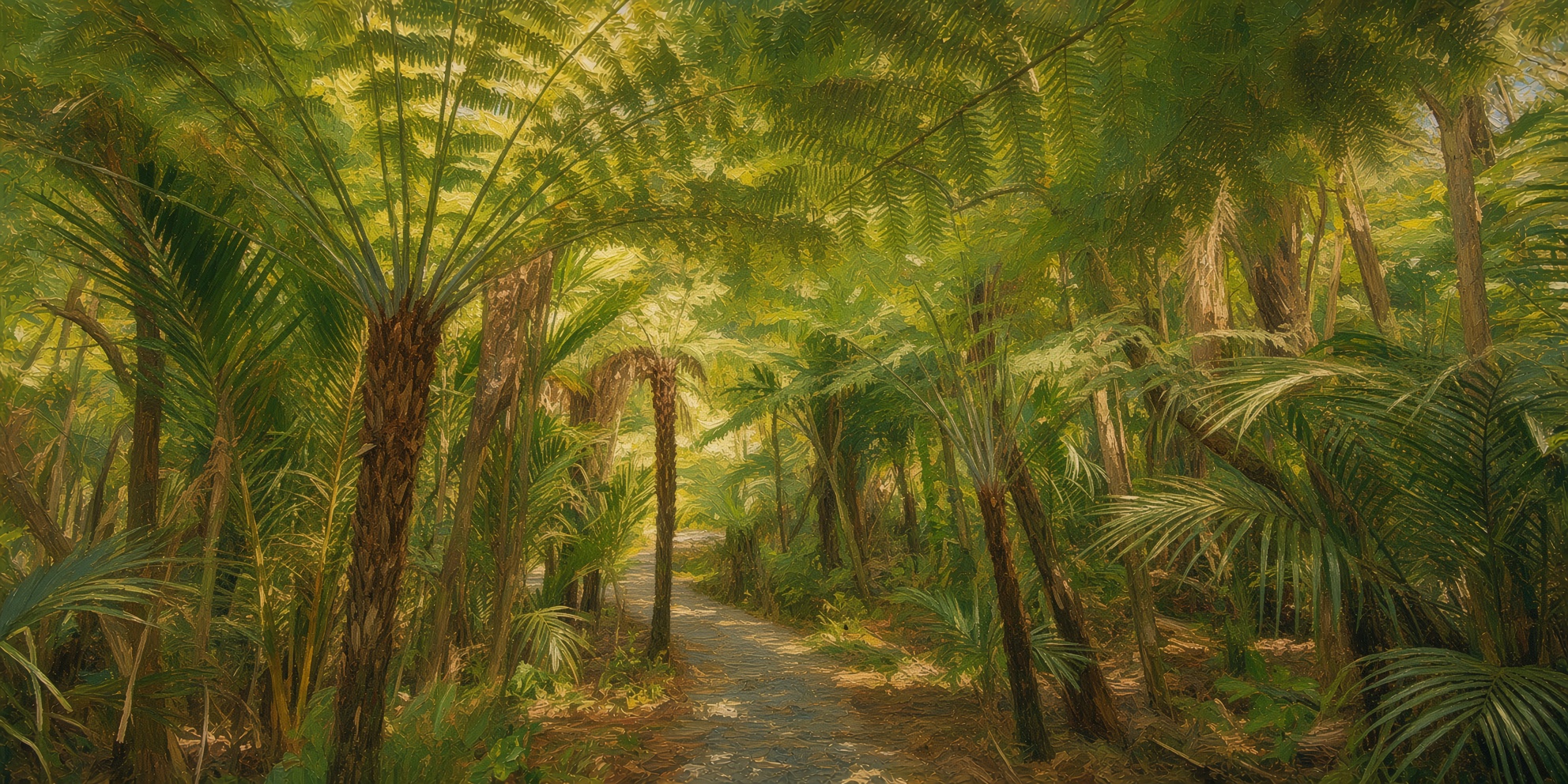
Auckland's parks and reserves network still looks impressive on paper. Aggregate green space per person ranks among the higher figures internationally, regional parks protect significant landscapes, and the city retains substantial public open space relative to many denser global peers. That headline comfort is misleading. The real trajectory is one of quiet erosion under intensification, uneven quality, capacity shortfalls in the places that need space most, and a political culture that prefers soft language over hard prioritisation.
Private backyards and gardens have been shrinking for decades as denser housing replaces them. Public parks and sports fields are expected to absorb the difference without matching investment or land acquisition. Canopy cover sits at roughly 18 per cent across the urban area against a long-standing target of 30 per cent by 2050 under Auckland's Urban Ngahere (Forest) Strategy, with some southern local board areas still well below 15 per cent. Sports fields face winter overuse, ageing infrastructure, and growing demand from higher-density populations. Research has identified a "green gap": people in more deprived neighbourhoods are less likely to use their nearest parks, often because of quality, safety, or perceived value.
The 2025 Manaaki Tāmaki Makaurau: Auckland Open Space, Sport and Recreation Strategy is the current policy response. Adopted in May 2025, it consolidates earlier documents and adopts a capacity-focused provision approach. Capacity is treated as low below 10 m² of qualifying open space per person, moderate between 10 and 20 m², and high above 20 m² (assessed at full build-out within relevant catchments). Acquisition and investment are to be directed toward high- and medium-density areas with low or moderate existing capacity. The strategy sets directions around equitable access to green, blue and grey space, innovative provision in high-density settings, climate resilience, biodiversity and heritage protection, and better integration of sport and recreation. It also contemplates commercial activity, partnerships, and the possibility of disposing of poorly performing open space to fund better outcomes.
This is directionally sound. Whether it becomes reality depends on whether Auckland is prepared to use the legal tools it already has with discipline rather than caution.
Legal reality, not aspiration
Most of the network is governed by the Reserves Act 1977. Classification under section 16 is mandatory and determines the primary purpose — recreation, scenic, historic, nature, local purpose, and so on. That purpose constrains what can lawfully occur on the land. Management plans under section 41 are required for the great majority of reserves. They must provide for use, enjoyment, maintenance, protection and (to the extent resources allow) development consistent with the classification and the statutory principles. The process demands public notice, invitation of suggestions, a draft plan open for at least two months, consideration of objections, and continuous review. Local boards, as administering bodies for most local parks, hold the decision-making power and the political exposure.
Revocation or change of classification under section 24 requires public notification of reasons and, in most cases, Ministerial involvement. It is deliberately not quick or quiet. Parallel processes under the Local Government Act 2002 apply to non-reserve parks. The Auckland Unitary Plan's Open Space zones tightly control activities; esplanade reserves remain mandatory on qualifying water bodies; tree protection rules in open space zones protect amenity and ecological values. Development contributions can only recover growth-related costs. None of this is optional window-dressing. Any future strategy that treats these processes as bureaucratic obstacles rather than the operating system will fail in court or in practice.
What best practice actually requires
Singapore's "City in Nature" approach demonstrates that high density and extensive greening are compatible when government controls land, enforces multi-tier planting and ecological corridors, expands park connector networks so households sit within a short walk of quality green space, and treats shade and biodiversity as infrastructure rather than amenity. Melbourne pairs an Open Space Strategy with an Urban Forest Strategy that targets significant canopy gains, prioritises access within roughly 300 metres, and uses detailed local analysis to identify gaps. The evidence-based 3-30-300 rule — three established trees visible from every dwelling, 30 per cent neighbourhood canopy, and quality public green space within 300 metres — provides a simple, measurable standard that cities can adapt. Copenhagen's sponge-city work shows how parks and streets can be engineered for flood resilience without sacrificing recreation.
These models share common features: clear metrics that are published and enforced; connectivity treated as essential infrastructure; quality and equity measured alongside quantity; multifunctionality kept subordinate to primary purpose; and funding that matches growth rather than lagging it.
The practical path for Auckland
First, make capacity non-negotiable. Complete and publish catchment-level capacity assessments for every urban area. Structure plans, private plan changes and Long-term Plan budgets must demonstrate how low- and moderate-capacity zones, especially in high-density and high-deprivation areas, will be addressed. Reject the comfortable claim that quantity is "not meaningful in isolation." Without a floor, equity evaporates.
Second, accelerate the Urban Ngahere Strategy with measurable annual targets and local-board-level accountability. Prefer multi-tier native and climate-resilient planting that creates ecological corridors, cools streets, and improves stormwater performance. Align street, park and private-realm greening so the 30 per cent regional target and 15 per cent local-board floor become reality rather than aspiration.
Third, rationalise the existing portfolio honestly. Identify low-function, poorly located or duplicated parcels. Run the full Reserves Act section 24 process with transparent reasons. Use proceeds strictly to acquire or develop higher-value open space in the same local board or capacity-deficit catchment. Parallel Unitary Plan rezoning will be required. Local boards must own the political cost; otherwise the network remains locked into historical accidents.
Fourth, treat sports fields and organised recreation as core social infrastructure. Deliver capacity upgrades, including artificial surfaces and lighting where winter demand justifies them, under the strategy's sports investment framework. Club arrangements must remain consistent with recreation reserve purposes and deliver measurable public benefit.
Fifth, fund the gap. Maximise development contributions for genuine growth-related needs. Rates must cover renewal and equity catch-up. Limited commercial activity is acceptable only where management plans and classifications allow and public access is not compromised. Partnerships and philanthropy are supplements, not substitutes for public responsibility.
Sixth, modernise management plans. Every local board needs current, measurable section 41 plans that include quality, usage equity, canopy, biodiversity and climate-resilience indicators, kept under continuous review. Shift from reactive maintenance to levels-of-service frameworks with independent audits.
The choice
Auckland still has the land, the legal framework and enough residual political capital to deliver a high-performing network. The alternative is a city in which aggregate hectares look fine while actual access, quality and capacity continue to decline in the neighbourhoods absorbing the bulk of growth. Soft language about "making all of Auckland our backyard" will not substitute for mapped capacity floors, enforceable canopy targets, disciplined rationalisation under the Reserves Act, and budgets that match the scale of intensification. The future of parks and reserves will be decided by whether decision-makers treat them as essential infrastructure or residual amenity. The tools already exist. The question is whether the will does.
Join the discussion
Community members are invited to add perspective, evidence, or a sharp question. Be specific and keep it civil.