Gold-Plated Safety and Geometric Denial
How Auckland Transport repeatedly abandoned simple design for ideology — and made ratepayers pay for infrastructure that sometimes had to be dug up again.
Auckland Transport has spent years delivering projects that ignore basic engineering economy, fixed geometry and network function in favour of ideological goals. The pattern is not subtle. Raised pedestrian tables costing hundreds of thousands of dollars, multimodal schemes forced into corridors too narrow to accommodate them, and cycle facilities whose unit costs tripled because standards and place-making overrode simple road-space reallocation. The results are higher costs, greater disruption, compromised capacity and, in some cases, infrastructure that had to be dug up again.
This is not poor project management in isolation. It is the predictable outcome of treating Vision Zero absolutism, complete-streets language and mode-shift targets as higher priorities than physics, property boundaries and value for money.
The Concrete Evidence
Raised pedestrian crossings under the Safe System / Vision Zero programme provide the clearest numbers. Williamson Avenue in Grey Lynn reached approximately $490,000, with traffic management alone accounting for $172,000. Hayr Road in Three Kings cost $463,000 to install a concrete table designed to last 40 years, then another $133,000 to remove it and reinstate a standard crossing after residents complained of noise and vibration. Total: roughly $600,000 for a net-zero result. A programme of 12 signalised crossings ran to $6 million. In multiple cases a basic zebra crossing or lower-profile platform would have delivered the safety benefit at a fraction of the cost and disruption. The ideology of "raised equals safer" overrode constructability and whole-of-life cost until political pressure forced a review.
Queen Street's pedestrianisation followed the same trajectory. An initial makeover and trial was costed near $1.1 million. The completed works reached $12.8 million for paving, planters and associated streetscape. Temporary management and modest permanent changes expanded into high-spec place-making under a "people-focused" framing.
Cycling and multimodal corridor projects show the same inflation. AT's own technical notes record unit costs rising from around $3 million per kilometre in 2017 to $8-11 million per kilometre. On typical projects, 50-70 percent of the escalation came from kerb relocation required by higher-width protected standards and the practical difficulty of simply reallocating existing space. Additional drivers included Vision Zero elements (more raised platforms), urban-forest requirements and place-making add-ons. Parallel routes or lower-spec solutions that stayed within the existing kerb lines were frequently diluted or rejected. Older business cases for some central cycleways also overstated demand.
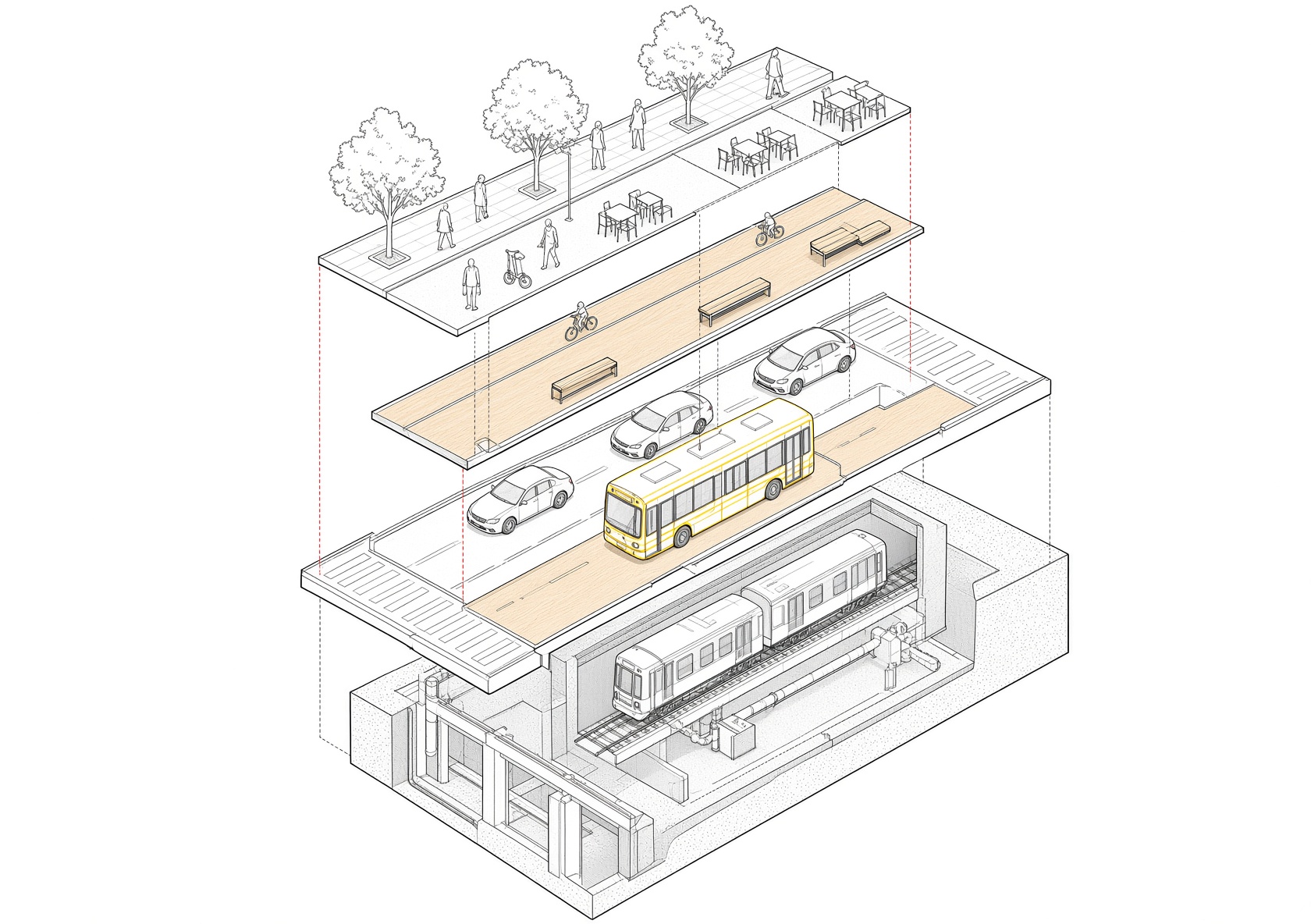
On constrained arterials the geometric problem is even more fundamental. Mt Eden Road, examined in AT's own 2015 analysis, had an average kerb-to-kerb width of 14.4 metres. Delivering dedicated bus facilities and separated cycle facilities to the standards of the time required 7.3 metres of widening without parking or 12.1 metres with parking. That scale of intervention is rarely affordable. The alternative-clear functional prioritisation with high-quality parallel cycle routes-was subordinated to the insistence that every corridor should serve every mode to a high standard.
Why Simple Principles Were Abandoned
The legal and policy settings of the period enabled the drift. The Land Transport Management Act requires efficiency and effectiveness in the Regional Land Transport Plan, yet mode-shift targets and Vision Zero commitments were treated as higher-order goals. The Transport Design Manual and Engineering Design Codes escalated preferred widths and treatments. "All users where practical" became default language in corridor plans. Business cases rarely forced hard trade-offs against geometry or quantified the capacity loss from multimodal packing. Community or internal pressure for place-making and absolute safety treatments further expanded scope.
The One Network Framework and Auckland's Roads and Streets Framework already provide the tools for prioritisation by movement and place function. They were not applied with sufficient rigour. The result was projects that delivered ideological outputs-protected facilities, raised tables, streetscape-while eroding total corridor capacity and inflating costs.
The Cost to the Network
Congestion already extracts an estimated $2.6 billion a year from Auckland by 2026, with 29 million hours of lost time.
Every dollar and every square metre of road space spent on gold-plated treatments that do not move more people more reliably is a direct subtraction from the network's ability to handle growth. When a $600,000 crossing is later removed, or when a constrained arterial loses general-traffic capacity without gaining reliable high-volume alternatives, the system becomes both more expensive and less functional.
How to Stop It Under the Existing Framework
No new legislation is required. The instruments already exist.
Apply the One Network Framework and Roads and Streets Framework as binding filters: primary function determines space allocation. Demand explicit trade-off tables and capacity analysis (people throughput before and after) in every corridor plan and RLTP submission. Enforce the Transport Design Manual's own warnings against intermediate bus/cycle widths and require documented justification for any departure from preferred minimums that increases cost or disruption. Use Better Business Case discipline to test "do less" and "parallel route" options against high-spec multimodal packages. Minimise scope to stay inside permitted activity rules under the Auckland Unitary Plan wherever possible, reserving Public Works Act acquisition for genuine strategic need only.
Political oversight has already forced some cost reviews. That pressure must become permanent institutional practice: every project that exceeds simple, functional design should face a public, quantified explanation of why the cheaper, less disruptive alternative was rejected.
Conclusion
Auckland Transport has repeatedly chosen ideological completeness over simple, effective engineering. The $600,000 crossing that had to be ripped out, the Queen Street project that ballooned from $1 million to nearly $13 million, the cycleways whose costs tripled because standards and place-making overrode reallocation, and the multimodal schemes forced into corridors that cannot physically accommodate them are not anomalies. They are the logical product of treating Vision Zero absolutism and complete-streets language as higher priorities than geometry, capacity and ratepayer value.
The legal tools to reverse this exist. What has been missing is the will to use them. Until corridor function, not slogan, dictates design, Auckland will continue to pay premium prices for compromised outcomes while congestion deepens.
Join the discussion
Community members are invited to add perspective, evidence, or a sharp question. Be specific and keep it civil.