
1. The principle: congestion is a timing problem as well as a capacity problem
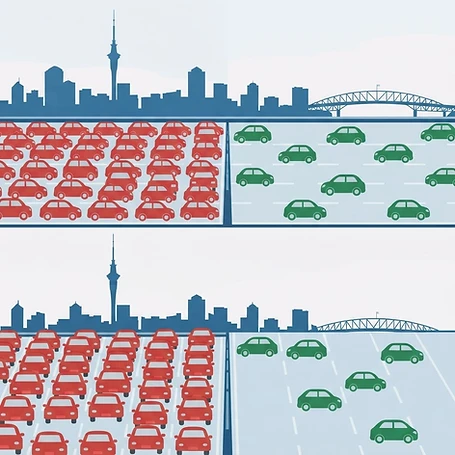
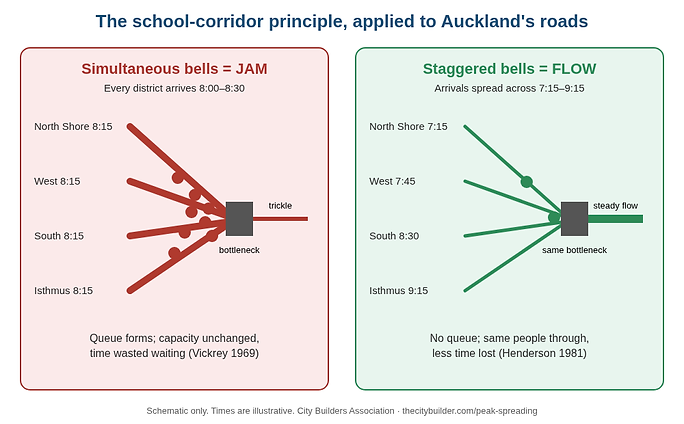
Vickrey's bottleneck model (1969). William Vickrey modelled a single road bottleneck used by commuters who all want to arrive at the same time. If everyone tries to pass through at once, a queue forms. Each commuter then trades off time lost in the queue against arriving earlier or later than they want to. In equilibrium, that queueing time is pure waste. The bottleneck still lets through only its capacity per minute, but people burn time waiting to use it. Vickrey showed that if departures were spread to match the bottleneck's capacity, the queue could in principle disappear while the same number of people got through. He argued for a time-varying toll to achieve this. Reference: Vickrey, W. S. (1969). "Congestion Theory and Transport Investment." American Economic Review, 59(2), Papers and Proceedings, 251–260.
Henderson on staggered work hours (1981). J. Vernon Henderson looked at what happens when employers, rather than individual commuters, choose work start times. He analysed how staggered hours reduce peak congestion, and how wages and the productivity of having staff in the office at the same time affect which work schedules hold up in equilibrium. His key point for policy is that firms do not bear the congestion costs their start times impose on other road users. Without coordination or incentives, too many employers cluster at the same start time. Reference: Henderson, J. V. (1981). "The Economics of Staggered Work Hours." Journal of Urban Economics, 9(3), 349–364.
What the evidence shows. A synthesis of large variable work-hours programmes by the US Transportation Research Board found peak-hour car traffic on major approaches to work centres fell by 5 to 10 per cent. Peak-hour bus loads and car arrivals at parking buildings fell by 10 to 20 per cent (NCHRP Synthesis 73). In Honolulu, about 3,500 public employees moved their start time 45 minutes later. Measured travel-time savings were 5 to 18 per cent in the earlier part of the peak, partly offset by small losses later in the morning (Transportation Research Record 1280, 1990). A 2024 simulation for a European city sounds a warning. Moving 10 per cent of peak demand improved delay, but moving 20 per cent overloaded intersections outside the old peak and made delay worse (Applied Sciences, 14(17), 7941). Peak spreading only works if it is designed and measured, and it does not work by default.
2. Benefits
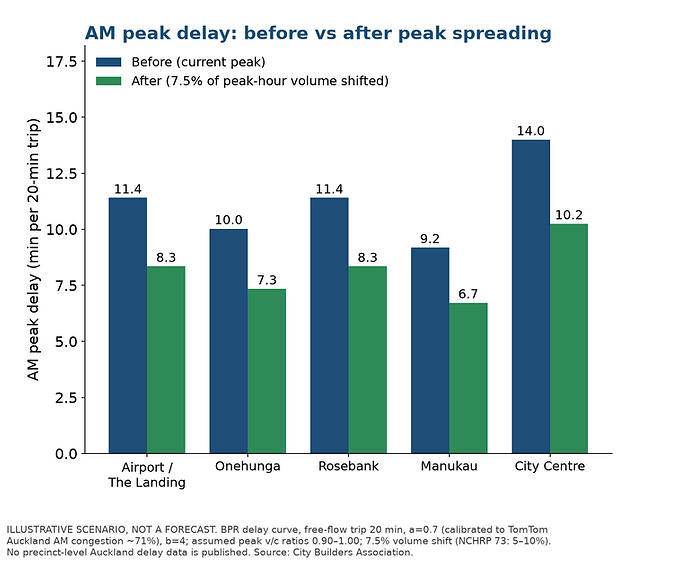
The ranges below come from cited studies outside Auckland. They have not been measured in Auckland. CBA's proposal is to test them here with a monitored pilot.
Capacity. 5–10% lower peak-hour traffic on approaches to participating work centres (NCHRP 73). For Auckland this is a hypothesis to be tested, not a forecast.
Delay. 5–18% travel-time savings on affected routes in the Honolulu staggered-hours trial. Small losses in later intervals meant the net benefit was positive but smaller.
Productivity. $0.9–1.3 billion a year is NZIER's 2017 estimate of the benefit of decongesting Auckland's roads to their design capacity on weekdays (1–1.4% of Auckland GDP). Peak spreading could deliver part of that.
Throughput. In Vickrey's model, spreading arrivals removes queueing time while the bottleneck keeps carrying traffic at full capacity, so the same number of people get through with less wasted time. This matters most where freight and staff share corridors, such as SH20/SH20A for the Airport, SH1 at Manukau and SH16 at Rosebank.
Context. TomTom's Traffic Index reports that Auckland drivers lose about 85 hours a year in rush-hour traffic. Average morning rush-hour congestion is 71.4 per cent (meaning trips take that much longer than in free flow) and average speed is 25.4 km/h. These are city-wide figures. Precinct-level figures are not published.

3. Incentive framework
- 1
Rates remissions or grants for verified shifts. Auckland Council would provide a rates remission, or a contestable grant, to a business or building that shows a verified 20–30 per cent shift of staff arrivals to at least 45 minutes outside the AM peak. The shift would be measured against a pre-pilot baseline. Remissions would need an amendment to Council's rates remission and postponement policy. Grants could be made under Council's general power of competence.
- 2
Enhanced Fareshare. Auckland Transport's Fareshare scheme already lets employers with five or more staff subsidise 25, 50, 75 or 100 per cent of employees' AT HOP fares. CBA proposes that AT co-fund a higher subsidy, or off-peak fare credits, for Fareshare employers that sign up to staggered start times. This would put demand into spare off-peak public transport capacity.
- 3
Consent-pathway recognition through AUP Chapter E27 (Transport). E27 Policy E27.3(1) already names travel planning as a way to manage the transport effects of trip-generating development. Policy E27.3(2) requires an Integrated Transport Assessment (ITA) for major discretionary proposals. CBA proposes that Council and AT guidance formally recognise a monitored staggered-hours commitment as a travel-planning measure in ITAs and consent conditions. That recognition could help with assessing trip-generation effects under Standard E27.6.1. Note: E27 does not set a stand-alone "travel plan" rule. The hook is the policy reference to travel planning and the ITA process.
- 4
Public sector leadership. Council, Council-controlled organisations, and central government agencies in the city centre and Manukau would pilot staggered start bands first, publish their results, and show the approach works.
- 5
Measurement with SCATS and analytics. Auckland's traffic signals are run on the SCATS adaptive system through the Auckland Transport Operations Centre (ATOC), a partnership of AT and NZTA. Before-and-after evaluation would combine SCATS detector counts and degree-of-saturation data, AT HOP tap-on profiles, building access logs (aggregated and anonymised), and travel-time data. Analytics, including AI-assisted pattern detection, would be used to separate programme effects from background trends and to find any new shoulder peaks early.
4. Critical constraints
Employment Relations Act 2000. Hours of work are part of an employment agreement. An employer cannot change them unilaterally, and any change must be agreed and negotiated in good faith. Part 6AA lets employees request flexible working arrangements, including changes to hours and days of work (s 69AAA). Employers must respond in writing within one month (s 69AAE) and may refuse only on the grounds listed in s 69AAF, such as burden of additional costs or detrimental effect on ability to meet customer demand. The programme must work through agreement, bargaining and these request mechanisms, not around them.
Voluntary only. Participation by employers and employees must be voluntary. Incentives reward outcomes. They do not make anyone change.
Avoiding deadweight. Council should not pay for shifts that would have happened anyway, such as existing shift patterns or hybrid work. To guard against this: require a pre-enrolment baseline, pay only for measured change above that baseline, cap payments per employee, and review results regularly.
Industrial shift work. Many workers at The Landing, Rosebank and East Tāmaki already start before 7 am or work rostered shifts. Their start times are tied to freight windows, port and airport schedules, and customer hours. Some sites have little room to move. The focus should be on office, administrative and back-of-house roles inside industrial precincts, and on aligning delivery windows, not just shifts.
Equity and caregiving. Changes to start times interact with school and early childhood education hours and with public transport frequency. Offer choice, not uniform later starts.
Over-shifting risk. The evidence shows that moving too much demand can create a new peak. Shifts should be capped and phased using SCATS monitoring.
5. Target precincts
City Centre
Employment
154,633 filled jobs (year to March 2025)
Source / note
Infometrics Auckland City Centre profile
Airport precinct (including The Landing)
Employment
~25,000 jobs; 25,400 people work on Auckland Airport land
Source / note
Auckland Airport. The Landing alone: not published
Manukau metropolitan centre
Employment
~17,000 workers (Transform Manukau project plan, mid-2010s estimate)
Source / note
Panuku/Eke Panuku (now Tātaki Auckland Unlimited)
Rosebank
Employment
8,000+ FTE across ~520 member businesses
Source / note
Rosebank Business Association
Onehunga
Employment
Not published (Business Onehunga represents 1,100+ business owners and landlords)
Source / note
Business Onehunga
Lincoln Road (Henderson)
Employment
Not published
Source / note
—
6. Legal foundation
- Local Government Act 2002, s 10. As replaced from 19 September 2026 by the Local Government (System Improvements) Amendment Act 2026, the purpose of local government includes meeting communities' needs for good-quality, cost-effective local infrastructure and public services, and supporting local economic growth and development (s 10(b)–(c)). Using existing road capacity better fits that purpose directly.
- LGA 2002, s 12. For the purposes of performing its role, a local authority has full capacity to carry on or undertake any activity or business, do any act, or enter into any transaction, subject to the Act, other enactments and the general law (s 12(2)–(3)). This is the basis for a grant scheme.
- LGA 2002, s 102. Lists the funding and financial policies a local authority must adopt (s 102(2)) and those it may adopt. Under s 102(3)(a) these include a rates remission policy.
- LGA 2002, s 109. A rates remission policy must state the objectives sought and the conditions and criteria for remission (s 109(1)). It must be reviewed at least every six years using consultation that meets s 82 (s 109(2A)).
- Local Government (Rating) Act 2002, s 85. A local authority may remit all or part of the rates on a rating unit if it has adopted a rates remission policy under LGA s 109 and is satisfied that the policy's conditions and criteria are met. It must notify the ratepayer (s 85(2)).
- Auckland Unitary Plan, Chapter E27 Transport. Objectives E27.2(1)–(2), Policies E27.3(1)–(2) on travel planning and Integrated Transport Assessments, and Standard E27.6.1 on trip generation.
- Employment Relations Act 2000, Part 6AA (Flexible working), ss 69AA–69AAM. "Working arrangements" include hours and days of work (s 69AAA). An employee may make a written request at any time (ss 69AAB–69AAC). The employer must decide as soon as possible and within one month (s 69AAE), and may refuse only on listed grounds (s 69AAF).
Section text checked against legislation.govt.nz on 14 October 2026. CBA's interpretation should still be confirmed by Council's legal team before any policy amendment.
7. Conclusion and next steps for Council
The quickest capacity Auckland can add costs little. It comes from using existing roads across a wider window of time. CBA asks Auckland Council and Auckland Transport to:
- Commission an 18-month pilot in two precincts, one office-based (City Centre) and one industrial (Airport/The Landing or Rosebank). The pilot would use public sector anchor employers and a SCATS-based baseline.
- Consult on an amendment to the rates remission and postponement policy to allow outcome-based peak-spreading remissions, with a parallel grant option.
- Work with AT on enhanced Fareshare for participating employers.
- Issue ITA guidance that recognises monitored staggered-hours commitments as travel planning under E27.
- Publish the evaluation, including deadweight and any shoulder-peak effects, before deciding whether to scale up.
Support the proposal → · founder@citybuildersassociation.org
All figures are referenced in the page sources. Modelled figures are labelled "Illustrative scenario, not a forecast".