Can't Cut the Collection? Shrink the Bin
Aucklanders said no to fortnightly rubbish pick-ups. Now council wants 80-litre bins as the default instead. Same truck, same street, a third less bin.
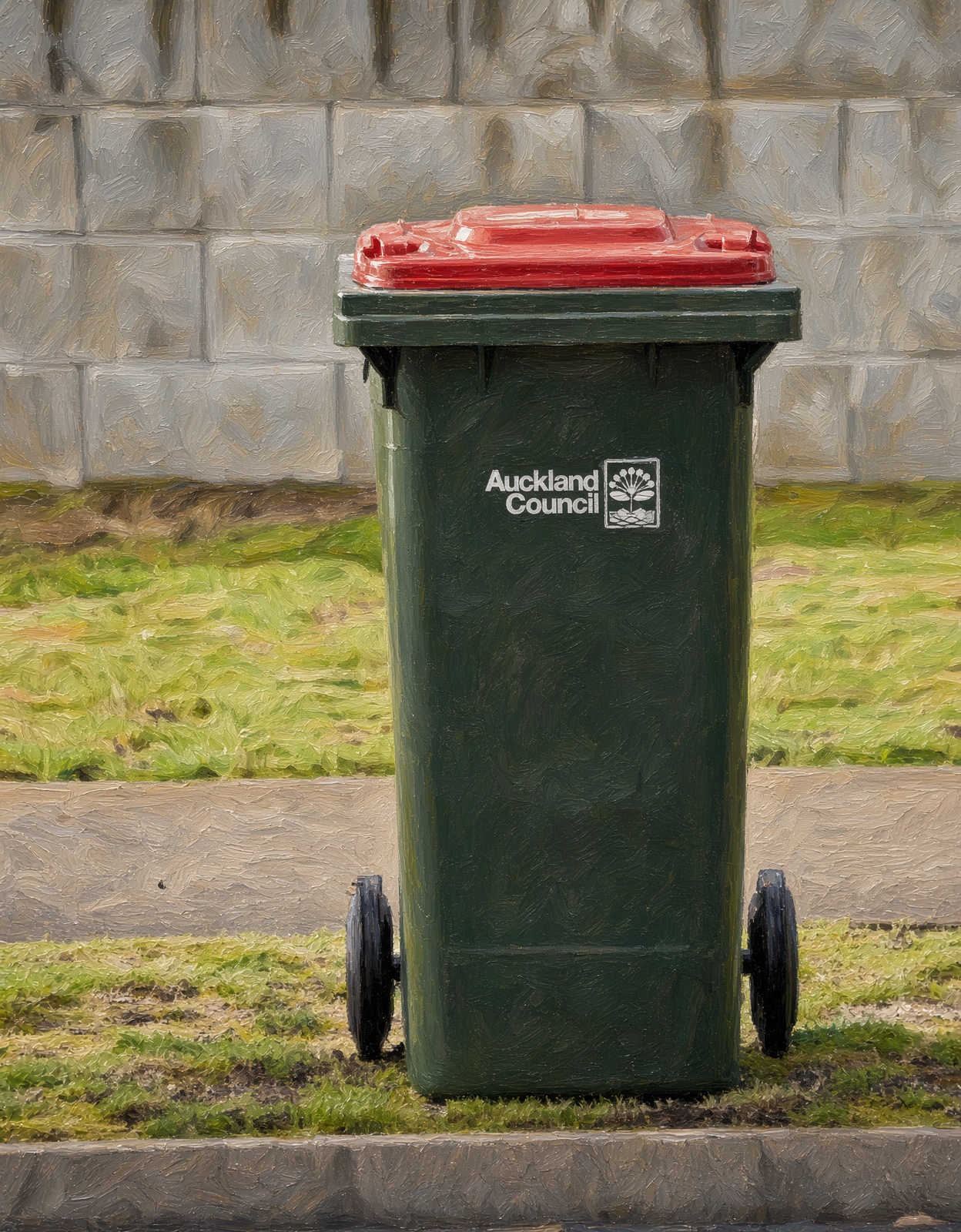
Last December, Auckland Council asked whether it could halve rubbish collections. Aucklanders gave a clear answer. Of the people who answered that question in the 5,086 submissions, 78 per cent opposed a trial of fortnightly pick-ups, and the council dropped it.
Eleven months later the same goal is back in a different form. On Tuesday 10 November, council's Policy, Planning and Development Committee voted 11 to 9, with one abstention, for the "target-focused approach". The staff report calls it the "strongest package": it would make the 80-litre bin, not today's 120-litre bin, the default option and widen the price gaps between bin sizes. If you can't cut how often the bin is emptied, you cut the size of the bin.
In the supermarket we call that shrinkflation.
What council has decided, and what it hasn't
Most Auckland households now have a choice of three rubbish bin sizes: 80 litres, 120 litres (the standard) and 240 litres. Some older North Shore and Waitākere properties still have 140-litre bins. You pay for the service through your rates, and the charge depends on the size of your bin.
According to the staff paper reported by The Post, the options put to councillors were:
- Free downsizing for households that move to an 80-litre bin.
- 80-litre bins: about $69–$119 a year, down from about $169 now.
- 120-litre bins: about $103–$153 a year, down from about $203.
- 240-litre bins: about $438–$488 a year, a steep rise.
The resolution itself says it "does not lock in the bin pricing". The total waste targeted rate stays the same, and any change to bin rates has to go through Annual Plan consultation. Nothing changes on your rates bill until that has happened.
Council's case
Council's case deserves a fair hearing. Its Waste Minimisation and Management Plan 2024 sets a target of cutting kerbside rubbish by 29 per cent per person by 2030. When that plan was consulted on, 66 per cent of respondents supported it and its targets.
Staff say food scraps and recyclables still make up a big share of what goes in red-lid bins. Bin audits show about 40 per cent of rubbish bins are half full or less when they're collected. The food scraps service has already cut kerbside rubbish to landfill by an estimated 9.3 per cent. In staff's words, "Increasing the price difference between rubbish bin sizes encourages households to make greater use of food scraps and recycling services."
That's a reasonable goal, and plenty of households will be fine with 80 litres. Some may even save money.
Why it still looks like shrinkflation
The standard service gets smaller. "Default" matters. Most people never change the bin they're given. Making 80 litres the starting point means the normal Auckland rubbish service gets a third smaller, while the truck still drives down your street every week and the fixed cost of running that truck doesn't shrink.
The cost moves onto households that need more space. Under the reported options, a 240-litre bin would cost around $438–$488 a year, against $324.96 on council's 2025/26 schedule. The households that need the big bin are usually the big ones: large families, multi-generational homes, and flats with several adults. Manurewa-Papakura councillor Daniel Newman put it bluntly: "The fact is the bin they need to meet their needs is going to be significantly more expensive."
Tenants don't get the choice. As Cr Newman pointed out, choosing a bin size is generally a matter for the property owner. A renting household could find itself with a smaller bin it didn't ask for and can't easily change.
Today's discount isn't tomorrow's price. Cheap small bins make a good launch offer. But once the default has shifted, the price gap is a dial council can turn in any future budget. Ratepayers have seen how quickly "targeted" charges climb.
Illegal dumping costs us all. Less bin space with no other change risks more rubbish on berms, in reserves and in public bins. Ratepayers then pay to clean it up. Submitters raised the same worry about the fortnightly trial.
How councillors voted
The decision was Item 8.4, "Alternative options to meet the kerbside waste reduction target", made by the Policy, Planning and Development Committee, a committee of the whole council (resolution PPDC/2026/165, moved by Cr Hills, seconded by Cr Filipaina). The names below are from council's draft minutes, which haven't been formally published yet, and will be rechecked once they are. Voting was electronic, and the meeting recording confirms the 11 to 9 result.
For the target-focused approach (11): Baker, Bartley, Fairey, Filipaina, Fuli, Henderson, Hills, Paterson-Hamlin, Sayers, Short and Deputy Mayor Simpson.
Against (9): Burns, Gillon, Lee, Newman, Turner, Watson, Williamson, Winiata and Houkura Member K Wilson.
Abstained (1): Fletcher.
Two amendments were lost first. The "business as usual" option, moved by Cr Newman and seconded by Cr Winiata, lost 9 to 11. The "incremental change" option, which the staff report describes as gradual, was moved by Cr Gillon and seconded by Cr Turner, and lost 10 to 11. The rest of the recommendations, PPDC/2026/164, were then carried on voices, with Cr Turner asking for his vote against to be recorded. Mayor Wayne Brown gave an apology for the meeting, citing council business, and Houkura Member Ngarimu Blair was also absent.
A better way to hit the target
CBA supports less waste going to landfill. But you get there by making the right choice the easy one, not by quietly shrinking a service people pay for:
- Fix food scraps uptake first. The service is already paid for through rates. Get more households using it before taking bin space away.
- Keep 120 litres as the default. Offer the free downsize and let households choose. If council's evidence is right, many will.
- Don't load the cost onto larger households. Price bins on the real cost of collecting them, not as a penalty.
- Give tenants a say. Let the household that actually uses the bin ask for a different size.
- Publish the numbers. Show the cost per household of each option, and the illegal-dumping risk, before consultation opens.
Have your say
The pricing changes have to go out for public consultation before they take effect. When submissions open, tell council what bin your household actually needs and what you think it should cost. CBA will publish the consultation link and closing date as soon as they're announced. Join the City Builders Association to get the alert and add your voice to ours.
Frequently asked questions
Is Auckland Council making rubbish bins smaller?
On 10 November 2026, council's Policy, Planning and Development Committee voted 11 to 9 for the target-focused approach, which the staff report says would make the 80-litre bin the default instead of the 120-litre bin. Households would be offered a free downsize. Bin pricing isn't locked in and still has to go through Annual Plan consultation.
Will a 240-litre rubbish bin cost more in Auckland?
Under the options reported from the staff paper, the annual charge for a 240-litre bin would be about $438–$488, compared with $324.96 on council's 2025/26 schedule. The final prices depend on consultation.
What happened to fortnightly rubbish collection in Auckland?
In December 2025, council's Policy, Planning and Development Committee decided not to go ahead with a six-month fortnightly collection trial in parts of Te Atatū Peninsula, Panmure/Tāmaki and Clendon Park/Weymouth. Of the submitters who answered the question, 78 per cent opposed it. Weekly collection continues.
Who voted for smaller rubbish bins in Auckland?
According to council's draft minutes, Baker, Bartley, Fairey, Filipaina, Fuli, Henderson, Hills, Paterson-Hamlin, Sayers, Short and Deputy Mayor Simpson voted for it. Burns, Gillon, Lee, Newman, Turner, Watson, Williamson, Winiata and Houkura Member K Wilson voted against, and Fletcher abstained.
Why does council want smaller bins?
To meet its target of cutting kerbside rubbish by 29 per cent per person by 2030. Council says many bins are half full or less at collection, and that much of what's in them could go in the food scraps or recycling bins.
Join the discussion
Community members are invited to add perspective, evidence, or a sharp question. Be specific and keep it civil.
No comments yet. Be the first to weigh in.
Written by Mark Pervan, Director, City Builders Association Limited
Mark Pervan is the founder and director of City Builders Association Limited, an Auckland civic think tank funded by membership and voluntary contributions. He has run manufacturing plants, with global sourcing and supply chain management in the same role, and has been project manager on multiple commercial and residential building projects. He was also responsible for product design and development across multiple mediums, and served as sales and marketing manager. He is a company director and business owner, including as a director of Idea Foundry. He served three years as an elected member of the Puketāpapa Local Board (2022–2025) and was a council candidate for the Albert-Eden-Puketāpapa ward of Auckland Council.
Mark on LinkedIn