The Empty Platforms Beneath Auckland's Busiest Station
Te Waihorotiu Station makes a strong cultural statement but leaves platform retail, advertising revenue and the natural surveillance they bring unrealised.
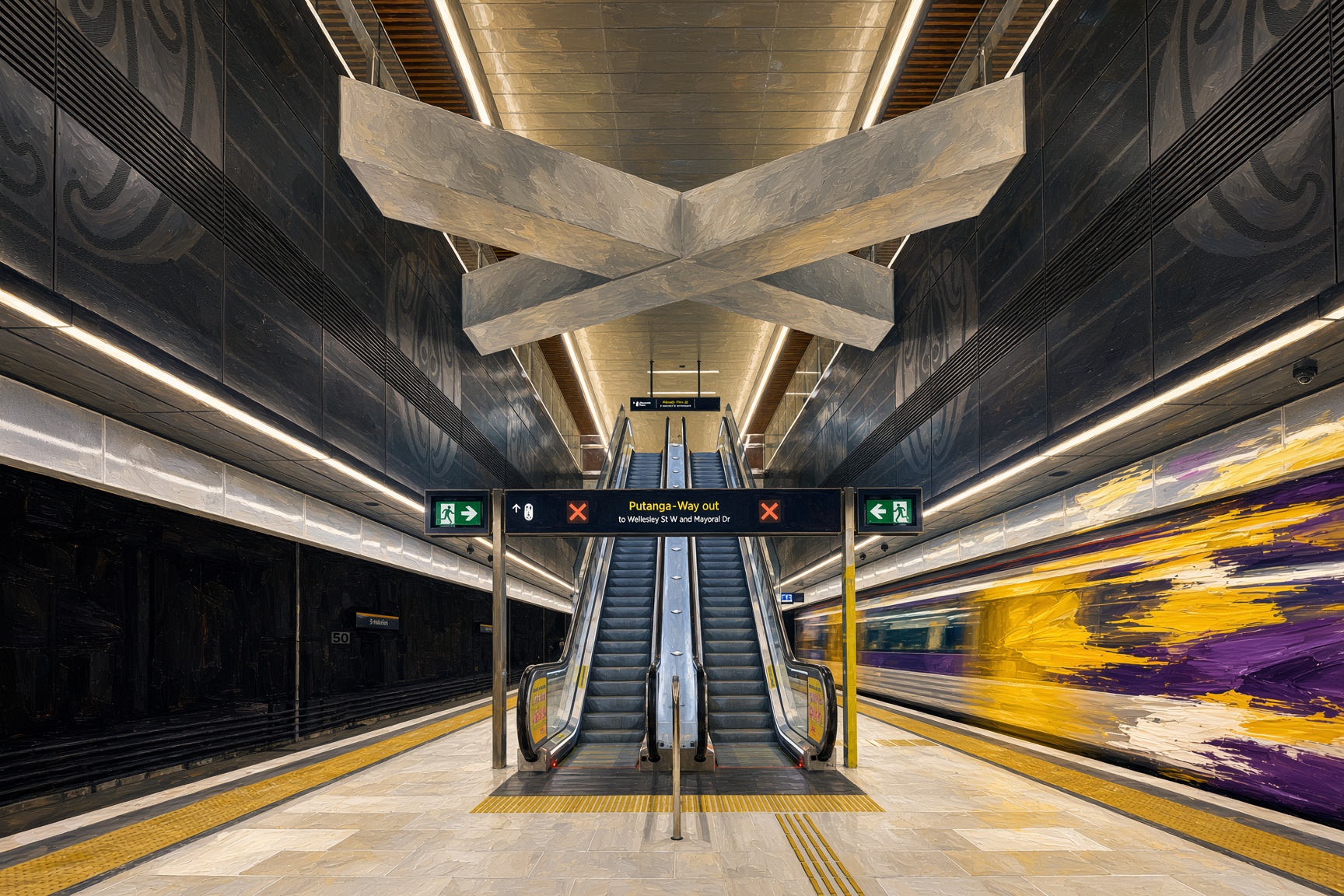
Te Waihorotiu Station opened in mid-September as the centrepiece of Auckland's City Rail Link, a 15-metre-deep underground station stretching roughly 300 metres beneath Albert Street with a 200-metre island platform future-proofed for nine-car trains. Auckland Transport expects it to become the country's busiest, with forecasts of about 34,000 boardings a day once patronage settles. It sits at the meeting point of the arts quarter, the universities, SkyCity and Queen Street, delivering people into the middle of the city for the first time rather than forcing them to the waterfront and back uphill.
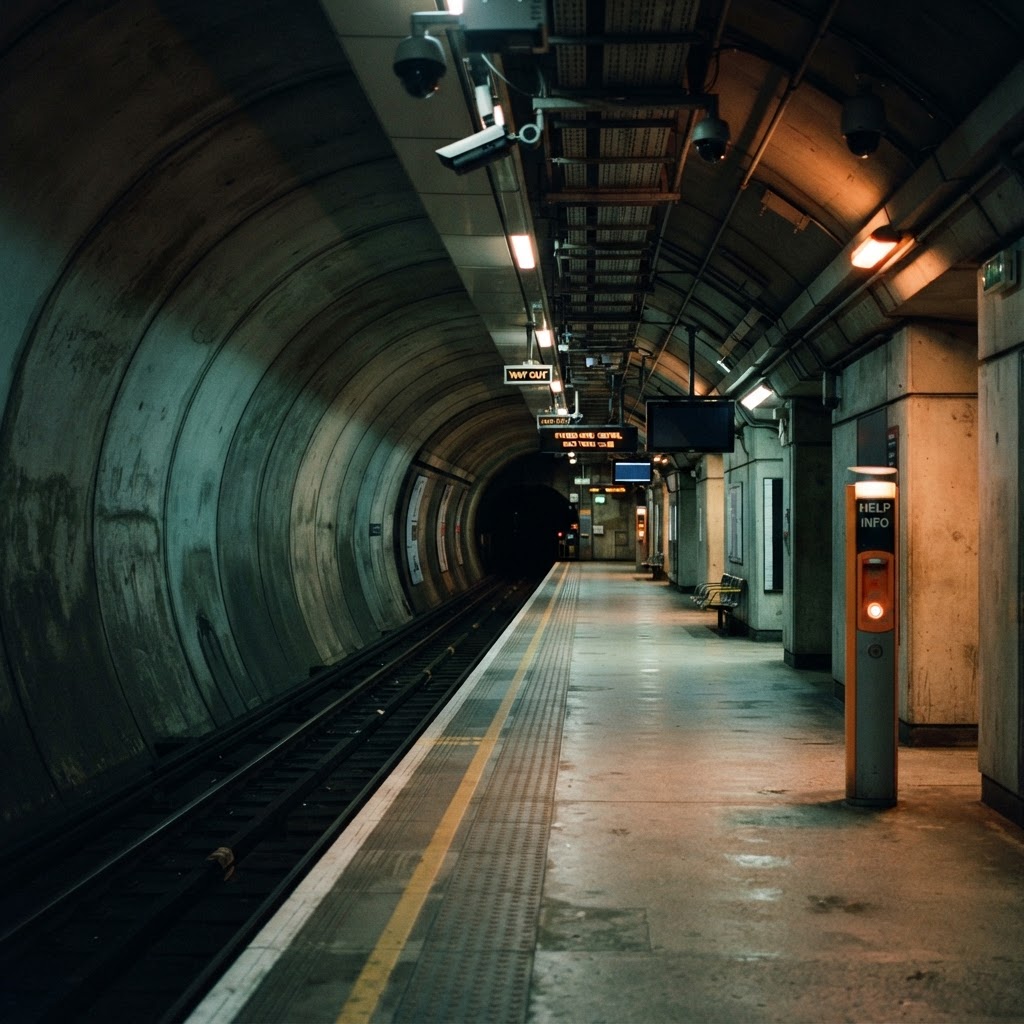
The platforms themselves, however, are almost entirely free of commercial activity. Retail is limited to small units at the street entrances, one of about 42 square metres on Wellesley Street that has already attracted interest, and an exploratory space of roughly 35 square metres at the Victoria Street end. Both are designed for frontage activation rather than deep engagement with waiting passengers, and both exclude commercial cooking. Digital advertising screens have been installed as part of a wider QMS network of around 29 screens across the new stations, yet the platform environment remains deliberately sparse. Cultural motifs, Matariki skylights, hanging rods that evoke the buried Waihorotiu Stream, and a clean architectural language take precedence.
This is unusual. In London, Tokyo, Singapore, Hong Kong and most major European and North American stations, platforms and their immediate approaches are treated as high-value commercial real estate. Dense poster and digital advertising, newsstands, coffee counters and convenience retail sit where people wait. Those stations convert captive audiences and dwell time into revenue while simultaneously placing staff who act as continuous natural surveillance. Te Waihorotiu's platforms do not. The choice produces a distinctive, culturally grounded space, but it also leaves measurable value unrealised.
The revenue gap is straightforward. Auckland Transport's broader advertising partnership is structured to return a minimum of $220 million over ten years across roughly 2,000 assets. Flagship locations with high dwell outperform the average. With 34,000 daily boardings and likely 50,000 to 70,000 total passages once alightings are counted, the platforms offer a substantial captive audience. Additional digital or large-format positions comparable to busy international peers could reasonably deliver an incremental one to three million dollars a year to Auckland Transport once the station matures, after operator shares. Retail adds further potential. Prime Auckland CBD net rents sit in the range of $2,500 to $3,500 or more per square metre. Even modest additional platform-adjacent kiosk space of 100 to 300 square metres, subject to flow and safety constraints, could generate several hundred thousand to over a million dollars annually in rent. Together the missed non-fare revenue sits in the low-to-mid single millions of dollars a year, material for a single station and useful against operating costs, though not transformative against the project's capital cost. These figures rest on public patronage forecasts, published retail benchmarks and Auckland Transport's own advertising revenue expectations; precise yields would require commercial appraisal, but the direction is clear.
There is also a safety dimension that is often overlooked. Store holders and their staff function as capable guardians. They provide the continuous human presence that cameras and periodic security patrols cannot fully replicate. International stations deliberately locate retail at platform level partly for this reason: occupied space raises the social cost of disorder, deters loitering, and improves perceived safety, particularly in off-peak and evening periods. Auckland One Rail and Auckland Transport have deployed security staff, transport officers, extensive CCTV and AI alerting, all of which are necessary. They are also more expensive and less continuous than commercial activity that pays for itself while delivering passive surveillance. Auckland Transport's own design guidance has long noted that retail can increase personal security during normal operating hours. The entrance units already contribute at the threshold; the platforms themselves do not.
None of this was prohibited. Auckland Transport holds the commercial rights and can lease space and place advertising under its statutory powers, advertising policy, resource management rules, health and safety requirements, and fire and life-safety standards. The existing units already operate under those constraints. Expanding carefully designed activation to platform level or immediately adjacent areas would have required the same compliance, coordination with security arrangements, and cultural review so that new elements did not undermine the mana whenua narrative. Retrofitting after opening is more costly and disruptive than designing the space in from the start. The restraint was a choice available within the legal and operational framework; denser, well-managed commercial presence was also available.
The result is a station that delivers a strong cultural and architectural statement at the expense of both non-fare revenue and natural surveillance. Ratepayers and farepayers carry more of the operating burden when commercial potential is left unrealised, and platforms that feel under-activated can suppress patronage growth outside peak hours. High-quality cultural design and responsible commercial activation are not mutually exclusive elsewhere. At Te Waihorotiu the decision was made to prioritise one over the other. That decision has a clear opportunity cost.
Join the discussion
Community members are invited to add perspective, evidence, or a sharp question. Be specific and keep it civil.
No comments yet. Be the first to weigh in.
Written by Mark Pervan, Director, City Builders Association Limited
Mark Pervan is the founder and director of City Builders Association Limited, an Auckland civic think tank funded solely by membership. He has run manufacturing plants, with global sourcing and supply chain management in the same role, and has been project manager on multiple commercial and residential building projects. He was also responsible for product design and development across multiple mediums, and served as sales and marketing manager. He is a company director and business owner, including as a director of Idea Foundry. He served three years as an elected member of the Puketāpapa Local Board (2022–2025) and was a council candidate for the Albert-Eden-Puketāpapa ward of Auckland Council.
Mark on LinkedIn