Council has priced sprawl's energy bill. It does not yet have a plan.
A compact Auckland would spend about $31 billion less on energy and transport fuel to 2035 than a sprawling one (present value). The Concept model, a who-pays rule and a grid test for housing growth are still missing.
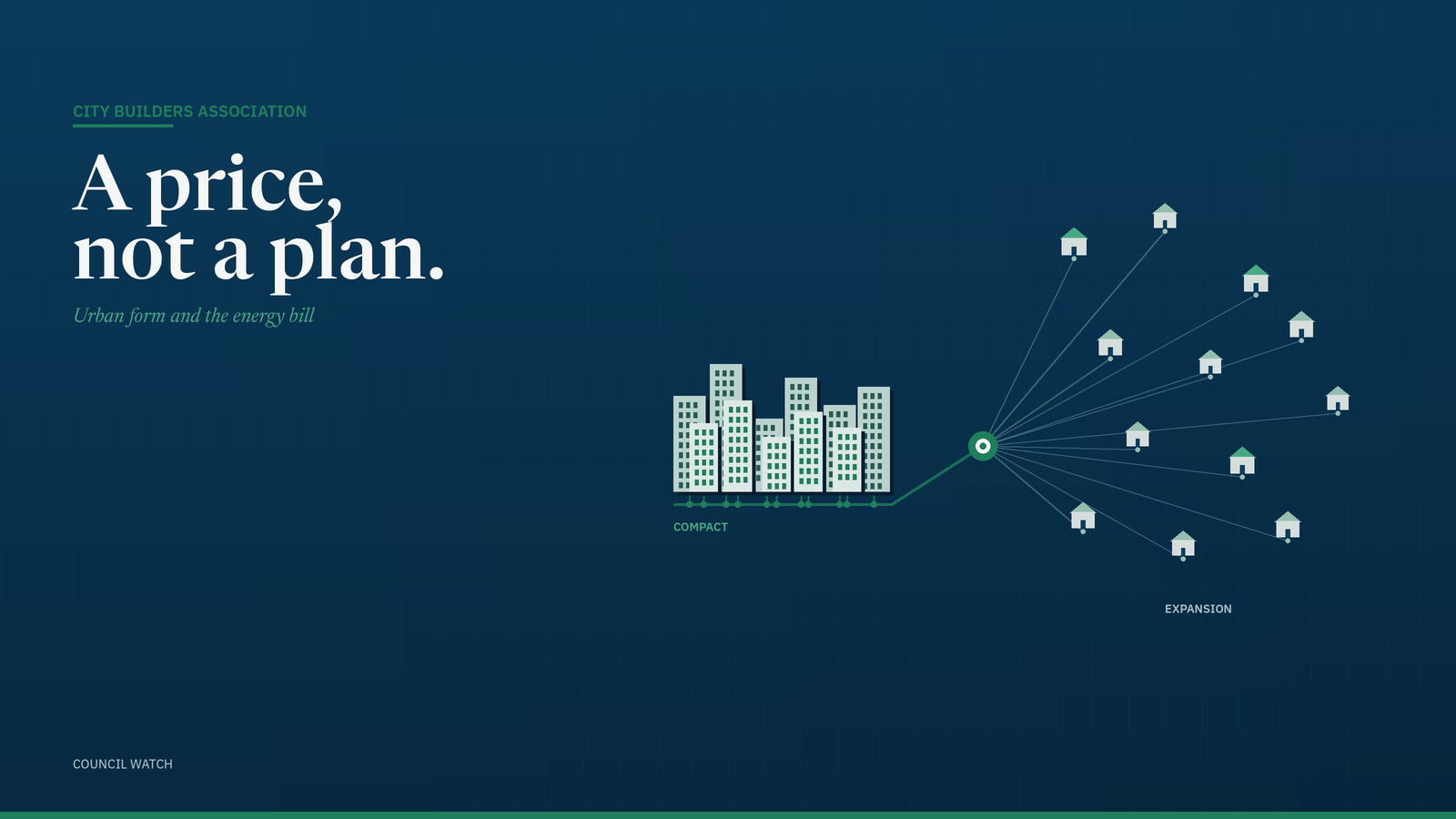
Auckland Council's Powering Auckland's Future Insights Report, released on 24 November 2026, does one thing well. It prices the energy cost of how the city grows.
Concept Consulting Group's modelling, as summarised by the council, finds that a Compact and Efficient pathway would lower regional capital and operating energy spending by about $17 billion to 2035 compared with business as usual, in present-value 2026 dollars. An Expansion pathway would raise that spending by about $14 billion, a gap of about $31 billion (p. 11). The figures exclude the transport infrastructure needed to change how people travel (p. 11). Some coverage, including RNZ, attributed the $14 billion to business as usual. The report, and the council's own release, attribute that figure to more dispersed, car-dependent growth.
The report is also clear on two delivery points. Managed EV charging is "the most immediate opportunity" to limit peak demand (p. 12). Under business as usual, EV uptake reaches about 90 per cent among the highest-income households by 2050, and about 20 per cent among the lowest; about 40,000 rented homes in Auckland have gas (p. 19). Those findings do not make this a plan.
The council "has not yet decided what role it will play in Auckland's energy future, and nothing here describes a decision already made" (p. 3). The report's main source is Concept's 2026 assessment, which "contains the full methodology, scenario results, cost analysis and appendices" (p. 24). That technical report has not been published. There are no adopted energy targets, and no named owner. Metro Vancouver's Climate 2050 Energy Roadmap sets 60 per cent clean, renewable energy by 2030 and 100 per cent by 2050, with 36 actions. Vienna's Heating Plan 2040 maps climate-neutral heat by 2040 for around 600,000 gas-supplied premises, and publishes the method. Calgary's Climate Strategy (June 2022) sets a 60 per cent emissions cut from 2005 by 2030 and net zero by 2050, tied to the city's budget cycle. Auckland has a bill. Those cities have an owner.
Second, there is no who-pays rule for growth-related network upgrades, and no link to rates, the long-term plan, or development contributions. Vector, which serves most of urban Auckland, "now proposes nearly $5.4 billion of capital investment over the 10 years to 2036" (p. 13). That is a regulated network programme, not a council budget line. Leaving it unallocated is a planning failure. If compact growth is the cheaper energy path, the council has to show how connection and upgrade costs will be treated when housing is consented and when the long-term plan is set. Local Government Act 2002, sections 14(1)(g) and 101(1), require prudent stewardship of resources and finances, and effective planning for future assets. They do not let the council set Vector's prices. They do require it not to rely on a $17 billion headline while remaining silent on who pays when new homes and vehicle charging hit the local grid. Copenhagen's energy strategy is explicit: distribution-grid expansion is funded by cost-reflective tariffs, time-differentiated charges are the standard, and distributors must publish 10-year network development plans every two years.
Third, land use is linked to the grid only in principle. The report suggests structure plans and major plan changes "should identify likely electricity demand, vehicle charging needs and electricity network timing before growth areas are committed" (p. 15). That is the right test. It is not yet a rule. There is no zoning-to-grid capacity requirement, no all-electric or EV-ready consenting standard, and no position on national building regulation, which the report lists as a central government control (p. 22). Calgary's 2030 milestones include net-zero new buildings and an EV-ready standard for new homes. Metro Vancouver's pathway has almost all new buildings electric by 2030. Western Australia's Distributed Energy Resources Roadmap assigned action owners and timeframes for solar, batteries and tariff design.
We ask three things of the council.
-
Release the Concept Consulting Group 2026 technical report, including the methodology, scenario results, cost analysis and appendices.
-
Take a regional energy transition plan to the Policy, Planning and Development Committee, with costs, an owner, and a clear who-pays answer for growth-related network upgrades, including how that sits in the long-term plan and development contributions.
-
Make grid capacity a housing-delivery test in Plan Change 120, structure plans and the long-term plan, so growth is not committed until electricity demand, charging needs and network timing are identified.
Until the model is public, the costs are allocated, and the planning rules match the finding, it remains a report.
Primary source: Auckland Council, Powering Auckland's Future: Urban form, energy and inclusive growth in Tāmaki Makaurau, Insights Report, November 2026, https://ourauckland.aucklandcouncil.govt.nz/media/ubckmwwk/powering-aucklands-future_web.pdf
Frequently asked questions
What did Auckland Council's Powering Auckland's Future report find about the energy cost of urban form?
Concept Consulting Group's modelling, as summarised by the council, finds that a Compact and Efficient pathway would lower regional capital and operating energy spending by about $17 billion to 2035 compared with business as usual, in present-value 2026 dollars. An Expansion pathway would raise that spending by about $14 billion, a gap of about $31 billion. The figures exclude the transport infrastructure needed to change how people travel.
Is Powering Auckland's Future a council energy plan?
No. The council "has not yet decided what role it will play in Auckland's energy future, and nothing here describes a decision already made." The report's main source is Concept's 2026 assessment, which has not been published. There are no adopted energy targets, and no named owner.
What does City Builders Association ask Auckland Council to do?
Three things: release the Concept Consulting Group 2026 technical report, including the methodology, scenario results, cost analysis and appendices; take a regional energy transition plan to the Policy, Planning and Development Committee, with costs, an owner, and a clear who-pays answer for growth-related network upgrades, including how that sits in the long-term plan and development contributions; and make grid capacity a housing-delivery test in Plan Change 120, structure plans and the long-term plan, so growth is not committed until electricity demand, charging needs and network timing are identified.
Does the report say who would pay for growth-related electricity network upgrades?
No. There is no who-pays rule for growth-related network upgrades, and no link to rates, the long-term plan, or development contributions. Vector, which serves most of urban Auckland, "now proposes nearly $5.4 billion of capital investment over the 10 years to 2036." That is a regulated network programme, not a council budget line.
Join the discussion
Community members are invited to add perspective, evidence, or a sharp question. Be specific and keep it civil.
No comments yet. Be the first to weigh in.
Written by Mark Pervan, Director, City Builders Association Limited
Mark Pervan is the founder and director of City Builders Association Limited, an Auckland civic think tank funded by membership and voluntary contributions. He has run manufacturing plants, with global sourcing and supply chain management in the same role, and has been project manager on multiple commercial and residential building projects. He was also responsible for product design and development across multiple mediums, and served as sales and marketing manager. He is a company director and business owner, including as a director of Idea Foundry. Since 18 November 2026 he has been Chair of the Dominion Road Business Association (DRBA). He served three years as an elected member of the Puketāpapa Local Board (2022–2025) and was a council candidate for the Albert-Eden-Puketāpapa ward of Auckland Council.
Mark on LinkedIn